

3 Ways to Buy a Home After 62—And the Lesser-Known Option That Could Improve Your Cash Flow

Guest Blog Post: Genie McGee | Retirement Mortgage Specialist | NMLS# 506550
When I speak with older-adult homeowners who have come to the realization that the home that served them well during their family-raising and working years may no longer be the right fit for retirement, I truly enjoy helping them explore what comes next.
Is moving the right decision? Is the timing right? How much home can they comfortably afford? And, if they decide to move, what’s the best way to fund the purchase?
Those questions are about much more than a mortgage. They’re about helping people determine what they want the next chapter of their lives to look like—and how their housing decisions can help support it.
Whether Moving Is the Right Move Now
Few decisions have as much impact on your lifestyle and well-being as where you choose to call home. From your hobbies and social life to your comfort, safety, cash flow, and monthly budget, so much revolves around your home and community.
For clients who are on the fence about moving, I’ll often start by asking what they love about their current home. Then I’ll ask them to imagine their ideal next home.
What about that home, lifestyle, or location excites them—and what could it offer that their current home doesn’t?
Some common responses include:
- Closer to family and friends
- Single-story, low-maintenance living
- New construction, offering a break from the ongoing repairs and upkeep of an older home
- A right-sized home that better fits their needs today
- A 55+ community offering amenities, activities, and opportunities to connect with people in a similar stage of life
- A better location, whether that means warmer weather, easier access to healthcare and shopping, or simply being closer to the things they enjoy
The goal isn’t to convince someone to move. It’s to help them determine whether a different home could better support the life they want to live in retirement, and whether now is the right time to make that move.
One concern I hear frequently sounds something like this:
“I’d love to move, but I have such a low interest rate on my current mortgage. And home prices where I want to buy are so high. Maybe I’m better off waiting until I can get a more manageable monthly principal and interest mortgage payment.”
Or, from homeowners who have already paid off their mortgage:
“I’m only interested in paying cash. I don’t want to take on a new monthly mortgage payment in retirement.”
I get it. Both perspectives are completely understandable.
But I still encourage my clients to explore all of their financing options before deciding how to purchase their next home.
Why? Because the way you finance a home can affect much more than the home itself. It can affect how much of your retirement savings you keep available, your monthly cash flow, and even how much purchasing power you have.
And for homebuyers age 62 and older, there’s a third option many have never heard of—one that may provide a very different way to approach their next home purchase.
That’s why, before deciding between paying cash or taking out a traditional mortgage, I believe it’s worth understanding all three options the family’s finances, investments, taxes, and retirement planning. Suddenly, after the loss of a spouse, they’re expected to make complex financial decisions while also navigating profound grief.
The Third Option: An H4P Loan
This is where I often introduce an option many of my clients have never heard of: the Home Equity Conversion Mortgage for Purchase, or H4P.
The H4P is designed specifically for homebuyers age 62 and older. It allows you to purchase a new primary residence using a combination of your own funds and reverse mortgage financing.
Here’s how I typically explain it: Instead of paying 100% cash for your next home—or putting money down and taking on a traditional monthly mortgage payment—you contribute a portion of the purchase price and the H4P finances the rest.
Depending on factors such as your age, current interest rates, and the value of the home you’re purchasing, your required down payment may be approximately 50%–75% of the purchase price.* Many of my clients use proceeds from the sale of their current home for that down payment, although other eligible funds, such as savings or investments, may also be used.
Now, here’s the part that usually gets people’s attention: With an H4P, you don’t have required monthly principal and interest mortgage payments.
That can be a big deal in retirement.
You get to purchase the home you want without having to commit all of your available cash to the purchase—and without adding a required monthly principal and interest mortgage payment to your retirement budget.
You still own the home and remain on title, just as you would with a traditional mortgage. And because the home secures the loan, you must continue to meet the loan obligations, including living in the home as your primary residence, maintaining it, and paying required property charges such as property taxes and homeowners’ insurance.
While repayment is deferred, interest and applicable fees are added to the loan balance over time. However, the H4P is a non-recourse loan, which means neither you nor your heirs will be responsible for repaying more than the home’s value when the loan becomes due and payable.**
I sometimes tell clients that, from a monthly cash-flow perspective, an H4P can feel a little like an all-cash purchase—but with one important difference: you may get to keep significantly more of your retirement assets available for other needs and goals.
Maybe that means keeping more of the proceeds from the sale of your current home. Maybe it means leaving investments invested, maintaining a larger emergency reserve, traveling, helping family, or simply having more financial flexibility in retirement.
And that’s why I believe the H4P deserves a place in the conversation. It isn’t necessarily the right choice for everyone. But if you’re 62 or older and considering a move, I think it’s worth comparing it side by side with the two options most people already know: paying cash and using a traditional mortgage.
So, now that you’re familiar with three different ways to buy a home after 62, let’s look at a hypothetical example to see how each could play out from a cash-flow perspective.
A Hypothetical Example: 3 Ways to Buy the Same Home
Sometimes the easiest way to understand the differences between these three options is to see how they might play out for a homebuyer. So, let me introduce you to Joanne.
Joanne isn’t a real client—she’s a fictional 70-year-old retiree I created to illustrate how paying cash, using a traditional mortgage, and using an H4P could affect someone’s cash flow and available savings differently.
Let’s say Joanne has found a $600,000 home in a neighborhood closer to her family. She expects to net about $500,000 from the sale of her current home, has another $200,000 in savings and investments, and receives approximately $1,600 per month from Social Security.
She loves the home and can afford to buy it. The question I’d want Joanne to consider is: What’s the best way for her to pay for it?

Option 1: Pay $600,000 Cash
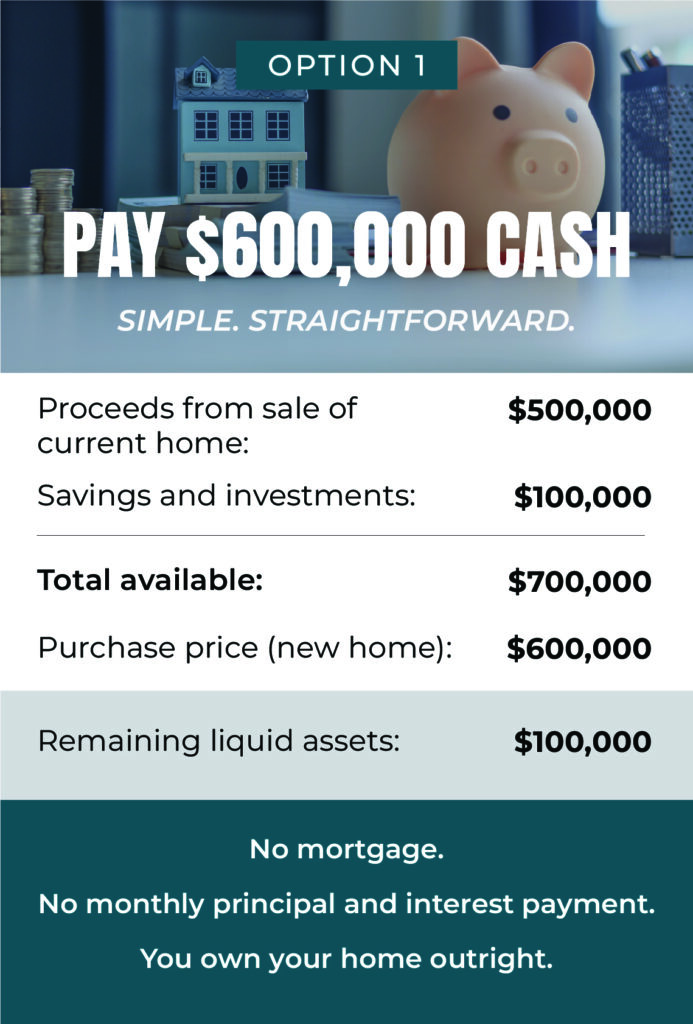
Joanne’s first option is probably the simplest. She could take the entire $500,000 from the sale of her current home, add another $100,000 from her savings and investments, and buy the new home outright.
The obvious advantage? No mortgage and no monthly principal and interest payment.
But I’d also ask Joanne to think about what happens to her cash. She started with $700,000 between her home-sale proceeds and savings and investments. After purchasing the home, only about $100,000 would remain liquid.
She’d have a $600,000 home, but a significant portion of her wealth would now be tied up in it.
For some clients, that’s perfectly acceptable. For others, preserving more accessible funds for healthcare, emergencies, travel, family, or simply peace of mind is extremely important.
Option 2: Use a Traditional 30-Year Mortgage
Next, let’s look at the more familiar financing option.
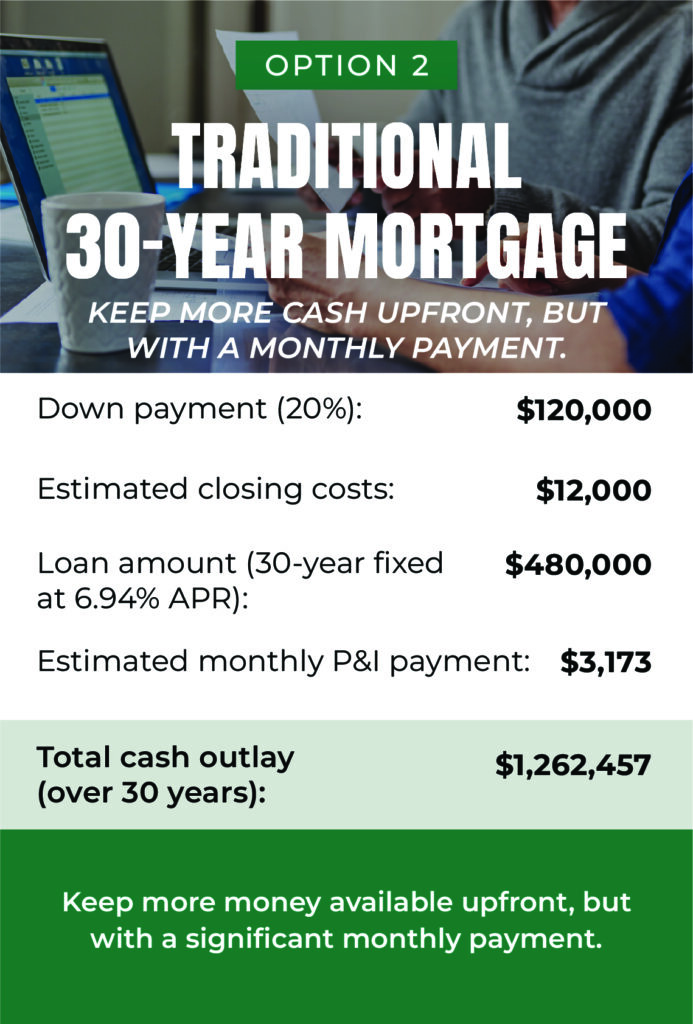
Joanne could put $120,000 down plus $12,000 in closing costs and finance the remaining $480,000 with a traditional 30-year fixed-rate mortgage. In this hypothetical example, assuming a 6.94% APR, her monthly principal and interest payment would be approximately $3,173.
This approach allows Joanne to keep considerably more of her money available upfront than if she paid cash. But there’s a trade-off: she now has a significant required monthly mortgage payment during retirement.
And this is where I’d want Joanne to look beyond simply asking, “Can I qualify for the payment?”
I’d also ask, “How will that payment affect the retirement lifestyle you want?”
A $3,173 monthly principal and interest payment is about twice the $1,600 in monthly Social Security income we assumed for Joanne in this example. That means a substantial amount would need to come from her sale proceeds and other retirement income or assets every month.
Over time, those required payments can have a significant impact on cash flow and financial flexibility.
If Joanne kept this mortgage for the full 30-year term, her total cash outlay—including the initial down payment, estimated closing costs, and principal and interest payments—would be approximately $1,262,457 in this hypothetical example. That illustrates the long-term cost of financing, although it also allows her to preserve substantially more of her assets upfront than paying $600,000 cash.
Option 3: Use an H4P Loan
Now let’s look at the option many homebuyers Joanne’s age don’t realize exists.
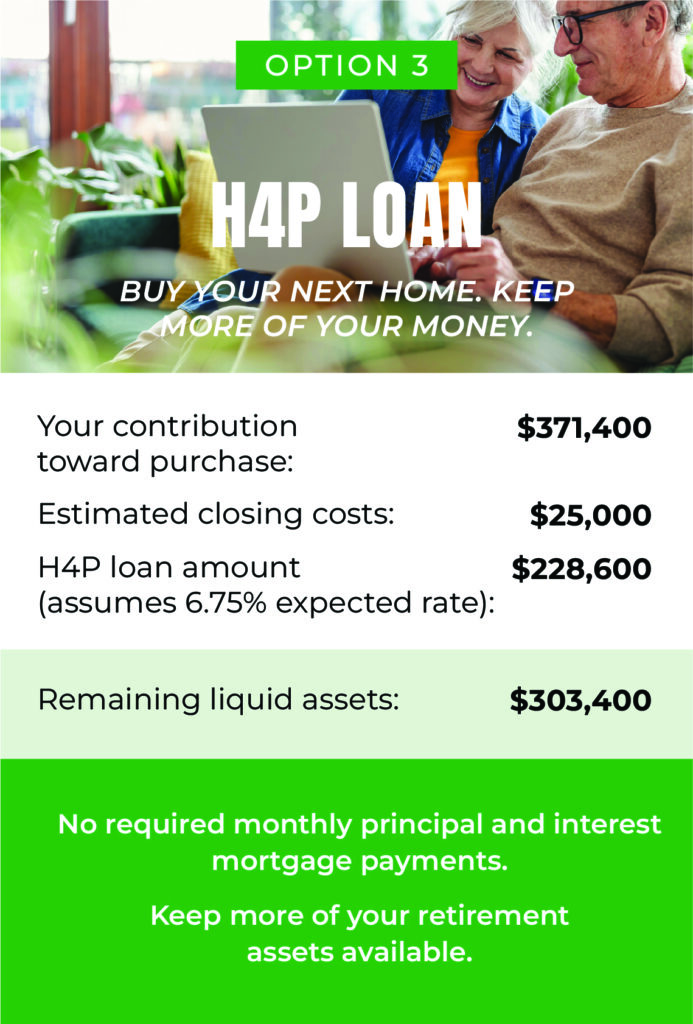
With an H4P (assuming 6.75 expected rate), Joanne could contribute $371,400 toward the purchase and finance the remaining $228,600 with the H4P loan. In this example, she would also have approximately $25,000 in estimated upfront closing costs, bringing her total initial cash outlay to approximately $396,400.
But instead of committing $600,000 to an all-cash purchase, Joanne would use approximately $396,600 upfront. Based on our hypothetical starting point, that could leave her with roughly $303,400 in available savings and assets—compared with about $100,000 after the all-cash purchase.
And here’s the key difference: Joanne would have no required monthly principal and interest mortgage payments with the H4P.
She would still be responsible for property taxes, homeowners insurance, home maintenance, and other applicable property charges, and she would need to continue meeting the terms of the loan.
That’s $204,400 more remaining outside the home than under the cash scenario, without taking on the required monthly principal and interest payment associated with the traditional mortgage in our example.
And that’s usually where I see the lightbulb go on.
The H4P isn’t about getting a home for less. It’s about changing how you use your money to buy it.
For someone like Joanne, that could mean purchasing the home she really wants, keeping more of her retirement assets available, and avoiding a required monthly principal and interest mortgage payment.
So, Which Option Is Best?
If Joanne were sitting across from me, I wouldn’t automatically tell her to choose the H4P—or any of these options.
I’d want to understand what matters most to her.
Does she value owning the home free and clear above everything else? Paying cash might appeal to her. Is minimizing the amount she puts down her priority, and can her retirement income comfortably support a monthly mortgage payment? A traditional mortgage might make sense.
But if Joanne tells me, “I want to buy this home, I want to keep more of my retirement money available, and I really don’t want another required monthly principal and interest mortgage payment,” then I’d absolutely want her to understand the H4P before making her decision.
Because sometimes the financing option you’ve never heard of may be the one that best aligns with the retirement lifestyle you’re trying to create.