

Locking In Today's Home Value: Why Timing Matters for Retirement Planning

Your Home Equity May Be More Important Than Ever
If you’re retired—or retirement is just around the corner—you’ve probably asked yourself a question with no easy answer:
“Will my money last?”
No one can predict how long retirement will last, whether inflation will remain elevated, how healthcare costs will change, or when the next market downturn may arrive.
Retirement planning has never been about predicting the future.
It’s about preparing for uncertainty.
Today, there’s another uncertainty worth considering:
What if today’s home value turns out to be tomorrow’s high-water mark?
For many homeowners age 62 and older, home equity represents their single largest financial asset. Yet historically, it’s often been treated as something to preserve for heirs or tap only as a last resort.
Increasingly, however, financial professionals are viewing housing wealth as an integral part of a comprehensive retirement strategy, alongside Social Security, pensions, investments, and other savings.
The conversation is shifting.
Instead of asking, “Should I ever use my home equity?”
Many retirees are beginning to ask:
“When is the most strategic time to use it?”
For some homeowners 62 and older, that answer may be before they actually need it.
Why Timing May Matter
After years of remarkable appreciation, some housing analysts believe certain markets could experience slower growth—or even price declines—over the next several years.
No one can predict future home values with certainty, and every local housing market is different. Still, several trends are prompting economists to watch the market closely.
Among them:
• Housing affordability remains near historic lows.
• Inventory has begun increasing in many markets.
• Large institutional investors have become net sellers of single-family homes.
• Demographic shifts will gradually place more homes on the market as baby boomers age.
• National median home listing prices have begun to soften, declining approximately 2.5% year over year.
No one knows what the housing market will do next. But planning ahead is almost always easier than reacting after circumstances change.
Which raises an important question…
If your home represents one of your largest retirement assets, should you evaluate your options while its value remains relatively strong?
Why Some Analysts Believe Home Prices Could Moderate
Home prices and mortgage rates have increased much faster than household incomes over the past several years.
According to Harvard’s Joint Center for Housing Studies, the income required to qualify for a median-priced home climbed from approximately $79,600 in 2021 to $126,700 in 2024.
As affordability declines, fewer buyers qualify—which can reduce demand and slow appreciation.
More Inventory May Be Coming
Millions of homeowners locked in historically low mortgage rates during 2020 and 2021.
Eventually, however, retirement, downsizing, health changes, estate settlements, and family transitions will bring many of those homes back to market.
Baby boomers alone own a significant share of America’s housing wealth. Over time, demographic turnover is expected to increase available inventory.
Institutional Investors Are Selling
Large investment firms spent years acquiring thousands of single-family homes.
Today, many are doing the opposite—reducing portions of their portfolios.
While this doesn’t necessarily signal an impending correction, it could increase housing supply and place downward pressure on prices in certain markets.
Long-Term Housing Cycles
Researchers including Homer Hoyt, Fred Harrison, Fred Foldvary, and Phil Anderson have documented recurring real estate cycles characterized by long periods of appreciation followed by correction.
These theories aren’t universally accepted and shouldn’t be interpreted as predictions.
However, they reinforce the importance of preparing for multiple outcomes rather than assuming today’s market conditions will continue indefinitely.
A HECM Line of Credit: Why Acting Earlier Can Matter
If your goal is to remain in your home, one of the most compelling retirement planning tools available for homeowners 62 and older may be the Home Equity Conversion Mortgage (HECM, reverse mortgage) line of credit.
Unlike a traditional home equity line of credit (HELOC), a HECM line of credit offers several unique advantages specifically designed for older homeowners.
Most importantly…
There can be significant advantages to establishing the line of credit sooner rather than later.
Why Acting Earlier Can Create More Opportunity
A HECM line of credit starts with an initial borrowing amount based largely on:
• Your age
• Current interest rates
• Your home’s appraised value (subject to FHA lending limits)
If home values decline in the future, homeowners who wait could qualify for less borrowing capacity than they would have today.
By establishing the line earlier, homeowners may be able to:
• Lock in borrowing capacity while home values remain strong.
• Allow unused borrowing capacity to grow over time.
• Build a reserve for healthcare, long-term care, home repairs, or emergencies.
• Access funds during market downturns instead of selling investments at depressed prices.
Why Financial Planners Like the HECM Line of Credit
Beyond preserving today’s home value, the HECM line of credit includes features rarely found in traditional lending products.
Growing Borrowing Capacity
Unused borrowing capacity grows over time at the same compounding rate applied to the loan balance.
That means your available line of credit can continue increasing—even if you never draw from it.
To illustrate, consider the following example based on an annual interest rate (compounded monthly) of 6.75% and no withdrawals made:
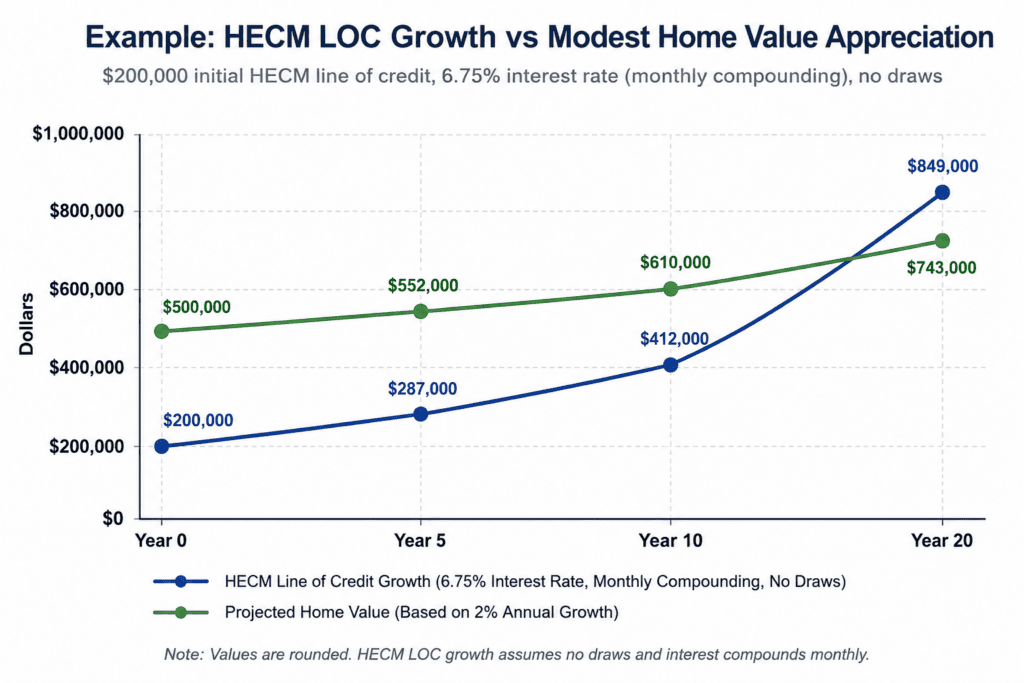
One feature that often surprises homeowners is that the available line of credit can eventually exceed the home’s value. That’s because the available borrowing capacity grows independently of future home appreciation.
No Required Monthly Mortgage Payments
Unlike traditional mortgages or HELOCs, HECM borrowers aren’t required to make monthly principal and interest mortgage payments.
Repayment is generally deferred until the last borrower permanently leaves the home, sells it, or passes away. Borrowers must continue paying property taxes, homeowners insurance, and maintaining the property.
Lifetime Access
Unlike most HELOCs that have draw periods lasting five to ten years, a HECM line of credit generally remains available for as long as the borrower occupies the home as a primary residence and continues meeting the loan obligations.
Your Credit Line Can’t Be Frozen Because Home Values Fall
Traditional HELOC lenders may reduce, freeze, or eliminate unused credit during economic downturns.
A HECM line of credit cannot be reduced simply because housing prices decline or market conditions change, provided the borrower remains in compliance with the loan terms.
Flexible Access
Borrow only what you need.
Repay it if you choose.
Borrow again later.
That flexibility makes the HECM line of credit less like a loan for emergencies—and more like a retirement funding reserve.
Built-In FHA Protection
A HECM is a non-recourse loan. If, when the loan becomes due, the loan balance exceeds the home’s value, neither the borrower nor the heirs are responsible for paying the difference.* FHA insurance covers any shortfall. Conversely, if the home sells for more than the loan balance, the borrower or heirs keep the remaining equity.
Planning to Move? Today’s Equity Could Help You Buy Better Tomorrow
Not every retiree plans to age in place.
Many homeowners reach retirement and realize the home that served them well for decades no longer fits their lifestyle. Some want to move closer to children or grandchildren. Others are looking for a single-story home, a warmer climate, a lower-maintenance property, or a community designed for active adults.
If that’s you, today’s home value may represent an opportunity to maximize the equity available from your sale before market conditions potentially change.
Many homeowners assume their only options are to pay cash for their next home or take on a traditional mortgage with required monthly principal and interest payments.
Fortunately, there’s another option worth exploring.
Buying Your Next Home with an H4P
A Home Equity Conversion Mortgage for Purchase (H4P) allows qualified homebuyers age 62 and older to purchase a new primary residence using a federally insured reverse mortgage.
Rather than paying the entire purchase price in cash, buyers typically contribute approximately 45% to 70% as a down payment,** depending on factors such as age, interest rates, and the home’s purchase price. The H4P finances the remainder.
Like a traditional HECM, borrowers aren’t required to make monthly principal and interest mortgage payments, although they must continue paying property taxes, homeowners insurance, and maintaining the home.
For retirees, that can create three meaningful advantages.
First, if today’s home values represent a market high—or close to one—selling now may allow homeowners to capture more equity before market conditions change.
Second, using an H4P may allow homeowners to preserve significantly more of those sale proceeds instead of tying them up in the next home.
Third, regardless of the interest rate environment, an H4P does not require monthly principal and interest mortgage payments. From a cash-flow perspective, it can feel much like an all-cash purchase—while preserving significantly more retirement capital.
More Equity Can Mean More Flexibility
Imagine a homeowner sells a longtime residence while values remain high and walks away with substantial equity.
Instead of investing nearly all of those proceeds into purchasing the next home outright, an H4P may allow them to keep a meaningful portion of that cash available for retirement.
Those funds could remain invested, provide a reserve for healthcare expenses, supplement retirement income, or simply offer greater financial confidence throughout retirement.
In other words, today’s home equity doesn’t have to disappear into tomorrow’s house.
It can continue working as part of an overall retirement strategy.
Let’s Start the Conversation!
Whether your goal is to age in place or purchase a home that’s better suited for retirement, the underlying principle is the same: today’s home value may present opportunities that could become more limited if housing prices moderate in the years ahead.
For homeowners planning to remain in their homes, establishing a HECM line of credit while home values are strong may help maximize available borrowing capacity today while allowing unused credit to grow over time for future needs.
For those planning a move, selling while values remain elevated and using a Home Equity Conversion Mortgage for Purchase (H4P) may help preserve liquidity, improve monthly cash flow, and keep more retirement assets working for you instead of being tied up in your next home.
The goal isn’t to predict where the housing market is headed.
The goal is to position yourself while you have the greatest number of options.
After all, successful retirement planning isn’t about reacting to uncertainty—it’s about preparing for it.