
Understanding Your HECM Reverse Mortgage: A Guide for Borrowers and Families

Whether you’re just beginning to explore a reverse mortgage or looking for guidance after your loan has closed, this four-part series walks you through every stage of the journey—from application through loan servicing and eventually the options available to you and your family when the loan becomes due and payable.
In This Series . . .
▶ Part 1: The HECM Reverse Mortgage Process: What to Expect from Application to Closing (Current Article)
Learn what happens before your reverse mortgage closes, including counseling, the application process, underwriting, appraisal, closing, funding, and what to expect every step of the way.
▶ Part 2: Your HECM Reverse Mortgage After Closing: What to Expect Throughout the Life of Your Loan
Discover what changes after closing, your ongoing responsibilities as a homeowner, how loan servicing works, managing your line of credit, annual occupancy certifications, common borrower questions, and practical tips for successfully managing your reverse mortgage.
▶ Part 3: When Your HECM Reverse Mortgage Becomes Due and Payable: Understanding Your Options
Learn what “due and payable” really means, what events trigger repayment, the options available to borrowers and heirs, how the non-recourse feature works, and what happens if the loan balance exceeds the home’s value.
▶ Part 4: A Guide for Heirs: What Happens After a Reverse Mortgage Borrower Passes Away?
Designed for family members and executors, this article explains what to do after a borrower passes away, including notifying the loan servicer, probate considerations, timelines, appraisals, repayment options, extensions, and settling the reverse mortgage with confidence.
Part 1: The HECM Reverse Mortgage Process: What to Expect from Application to Closing
If you’re considering a reverse mortgage, it’s natural to have questions about what the process involves. While obtaining a Home Equity Conversion Mortgage (HECM) may seem complicated at first, the journey is actually very similar to obtaining a traditional mortgage—and with the right team guiding you, it’s often much easier than many people expect.
Understanding each step ahead of time can help you feel more confident, reduce surprises, and make the experience much less stressful.
What Is a Reverse Mortgage?
A Home Equity Conversion Mortgage (HECM) is the most common reverse mortgage available in the United States and the only reverse mortgage insured by the Federal Housing Administration (FHA).
Designed for homeowners age 62 and older, a HECM allows eligible borrowers to convert a portion of their home equity into usable funds while continuing to own and live in their home. Depending on your needs, loan proceeds may be received as:
- A lump sum
- Monthly payments
- A line of credit
- Or a combination of these options
Unlike a traditional mortgage, required monthly principal and interest mortgage payments are not required as long as you continue meeting the loan obligations.
Borrowers remain responsible for:
- Paying property taxes
- Maintaining homeowners insurance
- Paying HOA dues, if applicable
- Keeping the home in reasonable repair
Repayment is generally deferred until the last remaining borrower permanently leaves the home, sells the property, or passes away.
Depending on your situation, a “proprietary” or “jumbo” reverse mortgage may be a better loan option, especially if you own a higher-value home (one that’s worth seven figures) or live in a condominium not approved by the FHA. Note: This article only details the process for obtaining a HECM.
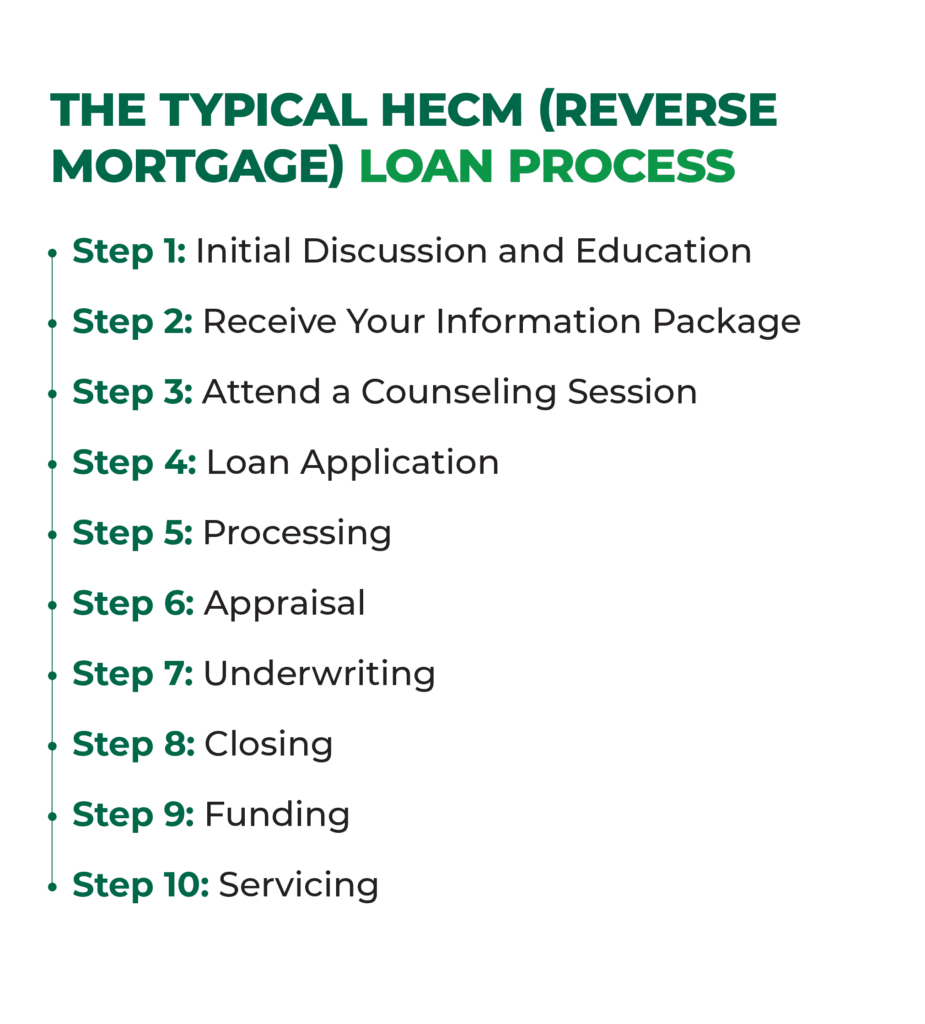
The Typical HECM (Reverse Mortgage) Loan Process
Although every borrower’s situation is unique, most reverse mortgages follow the same general process.
From start to finish, expect approximately 45 days from application to closing.
Let’s walk through each step.
Step 1: Initial Discussions and Education
Everything begins with a conversation.
You’ll meet with a licensed reverse mortgage professional to discuss your goals, answer your questions, and determine whether a HECM may be appropriate for your situation.
Topics typically include:
- How reverse mortgages work
- Basic eligibility requirements
- Estimated loan proceeds
- Loan costs
- Available payout options
- Alternatives that may also meet your needs
There’s no obligation to move forward. The purpose of this meeting is education—helping you decide whether a reverse mortgage aligns with your retirement goals.
Your loan originator may also ask you to complete a brief pre-application questionnaire to determine your preliminary eligibility.
Step 2: Receive Your Information Package
If you decide to continue exploring a reverse mortgage, your loan originator will provide a pre-counseling information package.
This package generally includes:
- A list of national and local counseling agencies (more on that in a bit
- A comparison of various product options
- A disclosure on the total costs of the loan
- An amortization schedule that describes the rate at which the loan accrues and other fees over time
- A helpful “Use Your Home to Stay at Home” guide produced by the National Council on Aging (NCOA)
Step 3: Attend a Counseling Session
HUD counseling is a required part of every HECM transaction.
Counseling is conducted by an independent counselor approved by the U.S. Department of Housing and Urban Development (HUD)—not by your lender.
The purpose is to ensure you fully understand:
- How reverse mortgages work
- The costs and obligations
- Alternative options
- Whether a reverse mortgage appears appropriate for your situation
Counseling can usually be completed by telephone or in person.
All borrowers must participate, and family members are encouraged to attend as well. After the session, you’ll receive a counseling certificate that must be signed before your loan application can proceed.
Step 4: Loan Application
Once counseling has been completed, you’ll formally apply for the loan.
Like a traditional mortgage, you’ll provide documentation such as:
- Proof of income
- Mortgage statements
- Bank statements
- Identification
- Other supporting documents requested by your lender
During this step, you’ll also choose how you’d like to receive your reverse mortgage proceeds.
Options may include:
- Lump sum at closing
- Monthly payments
- Line of credit
- Combination of payment options
Your loan team will begin collecting the remaining documentation needed to move your application forward.
Step 5: Loan Processing
After your application is complete, your file moves to the processing department.
The processor reviews your documentation and orders several third-party services, including:
- Title work
- Flood certification
- Property appraisal
- Other required verifications
If additional information is needed, your processor will contact you.
Their goal is to prepare a complete loan package for underwriting.
Step 6: Appraisal
One of the most important steps is the appraisal.
An independent licensed appraiser visits your home to determine its current market value.
The appraisal also confirms the property meets FHA minimum property standards.
Several factors help determine how much you may qualify to borrow, including:
- The appraised value
- The age of the youngest borrower (or eligible non-borrowing spouse, if applicable)
- Current interest rates
Occasionally, HUD may require a second appraisal to ensure accuracy. To get a ballpark idea of how much you may qualify for, try our online HECM calculator.
Step 7: Underwriting
Once processing is complete, your file moves to underwriting.
The underwriter reviews every aspect of your application to ensure it meets FHA requirements.
Unlike a traditional mortgage, underwriting focuses less on your ability to make monthly mortgage payments and more on your ability to continue meeting your ongoing property obligations, including:
- Property taxes
- Homeowners insurance
- HOA dues, if applicable
If necessary, the underwriter may require a Life Expectancy Set-Aside (LESA), which reserves a portion of your loan proceeds to help pay future property taxes and homeowners insurance.
Once all underwriting conditions have been satisfied, your loan is declared clear to close.
Step 8: Closing
Next comes closing day.
Depending on your lender and state, closing may take place:
- At your home
- At a title company
- At an attorney’s office
- Or another convenient location
You’ll review and sign your final loan documents.
Your loan professional will explain the paperwork and answer any final questions before the documents are completed.
Note: With Fairway’s new, optional hybrid eClosings, HECM borrowers can securely review and e-sign most documents from home—starting at midnight on closing day—allowing them to absorb the details at their own pace.
Step 9: Funding
If your reverse mortgage refinances an existing home, federal law provides a three-business-day right of rescission,, allowing you to cancel the transaction if you change your mind.
After that period expires:
- Existing mortgages or liens are paid off
- Your reverse mortgage becomes effective
- Any initial loan proceeds are disbursed according to your selected payment option
If you’re receiving funds at closing, they generally arrive within several business days after funding.
Step 10: Servicing
Although your loan has closed, your reverse mortgage journey is just beginning.
After closing, your loan will typically be managed by a professional loan servicer. More to come regarding that later in this series of articles.
Continue the Series
Read Part 2: Your HECM Reverse Mortgage After Closing: What to Expect Throughout the Life of Your Loan